Design a Decade Counter Using T Flip-flops
CS302 - Digital Logic & Design
Lesson No. 29
UP/DOWN COUNTER
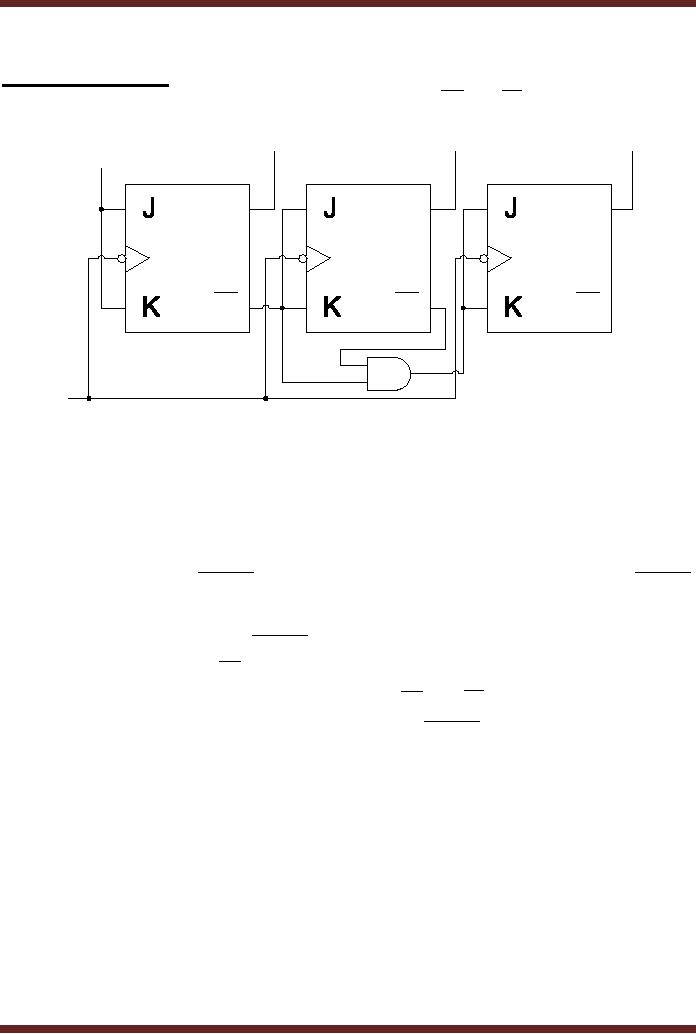
The down-counter is implemented by connecting the Q 0 and Q 1 outputs. Figure 29.1
F 0
F 1
F 2
1
SET
SET
SET
Q
Q
Q
flip-flop 1
flip-flop 2
flip-flop 3
Q
Q
Q
CLR
CLR
CLR
CLK
Figure 29.1
3-bit Synchronous Down-counter
The down-counter counter circuit is very similar to the up-counter circuit discussed
earlier. The only change is the connection of the AND gate to the complementary outputs of
the first and second flip-flops.
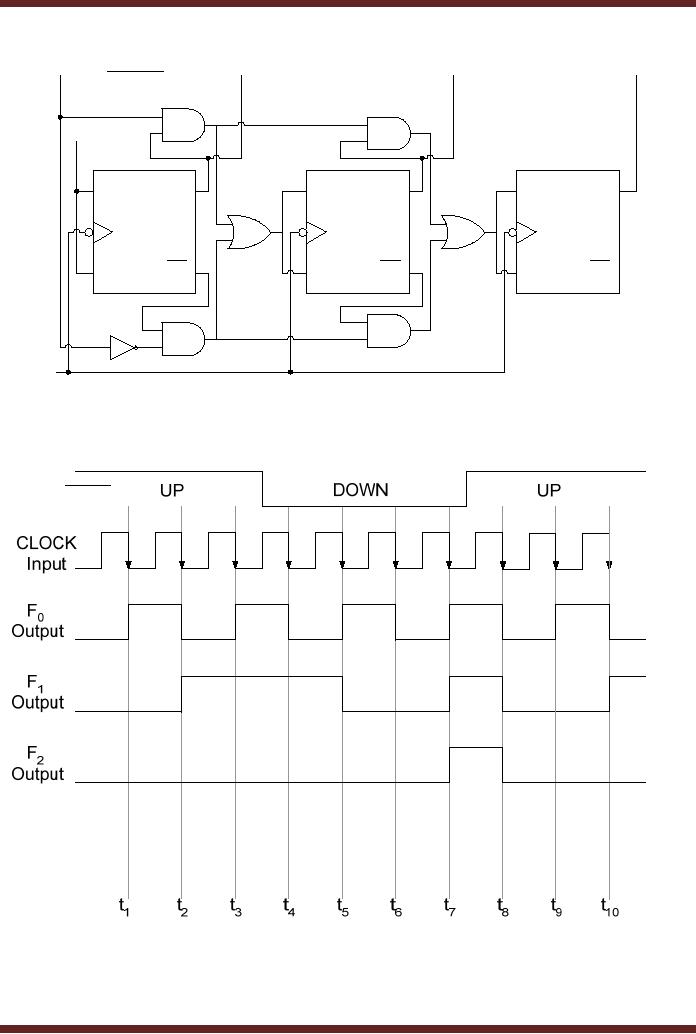
The up-counter and down-counter can be implemented as a single counter circuit by adding
some extra logic. In the circuit diagram, the Up-down counter is configured to count up or
down by setting the UP / DOWN input to logic 1 or 0 respectively. When the UP / DOWN
input is set to logic 1, upper AND gates are enabled, allowing flip-flip 2 to toggle its state when
F 0 output of flip-flop 1 is logic 1. Similarly when both F 0 and F 1 outputs are logic 1, flip-flop 3
toggles its state. When the UP / DOWN input is set to logic 0, the lower AND gates are
enabled. When F 0 is logic 0, Q 0 is logic 1 and the flip-flop 2 toggles its output state. Similarly,
when both outputs F 0 and F 1 are at logic 0, that is, Q 0 and Q 1 are at logic 1 the flip-flop 3
toggles its state. During the counting sequence, the UP / DOWN input can be set to logic 1 or
0 at any time to reverse the counting sequence. Figure 29.2
293
CS302 - Digital Logic & Design
F 0
F 1
F 2
UP / DOW N
1
SET
SET
SET
J
Q
J
Q
J
Q
flip-flop 2
flip-flop 1
flip-flop 3
K
Q
K
Q
K
Q
CLR
CLR
CLR
CLK
Figure 29.2a Up-Down Synchronous Counter
UP / DOWN
Figure 29.2b Timing diagram of an Up-Down Synchronous Counter
294
CS302 - Digital Logic & Design
Integrated Circuit Up/Down Decade Counter
Implementing a 4-bit Up/Down counter by connecting flip-flops and logic gates
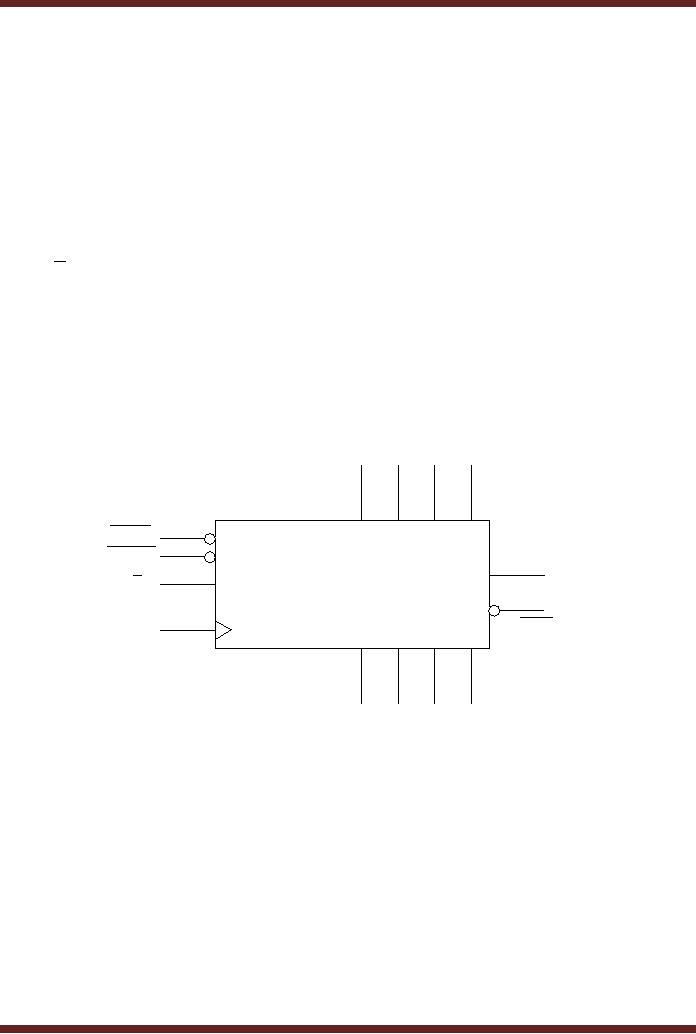
increases the circuit size and requires many connections. The 74HC190 is a 4-bit Up/Down
Synchronous Counter available in an Integrated Circuit form. Figure 29.3. The counter has the
following pins.
1.
Parallel data inputs D 0 , D 1 , D 2 and D 3
2.
Data outputs Q 0 , Q 1 , Q 2 and Q 3
3.
Positive edge-triggered CLOCK signal
4.
Active-low LOAD input which loads the 4-bit data applied at the counter inputs
5.
Active-low CTEN counter enable input
D / U the count down/up input. When the input is set to logic 1, the counter counts down
6.
and when the input is set to logic 0, the counter counts up
7. The MAX/MIN output that is set to high when the terminal count 1001 is reached when
counting up or when the terminal count 0000 is reached when counting down. The
MAX/MIN output is logic high for one complete cycle when a terminal count is reached.
8. The Ripple Clock Output RCO goes low when the Counter reaches the terminal count
1001 or 0000 when counting up or down respectively. The RCO output remains low during
the negative half of the clock cycle. The RCO, the MAX/MIN output along with CTEN input
is used to cascade multiple counter ICs for implementing larger counters.
D 0 D 1 D 2 D 3
CTEN
LOAD
MAX/MIN
74HC190
D/U
RCO
CLK
Q 0 Q 1 Q 2 Q 3
Figure 29.3
74HC190 4-bit Synchronous Up/Down Counter
Counter Decoding
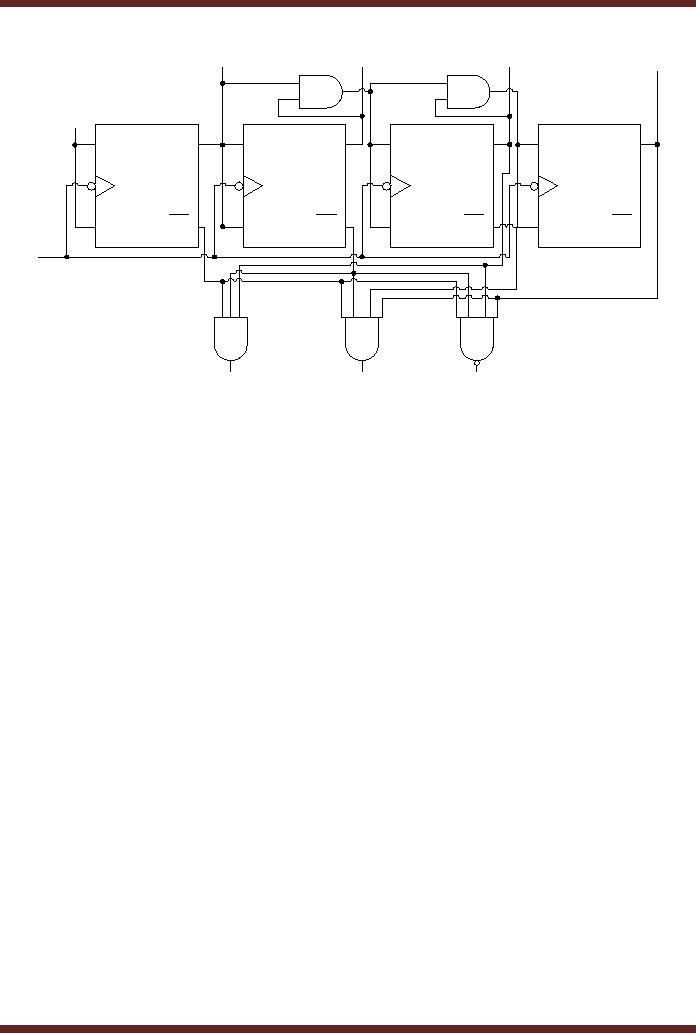
In digital circuits the counter outputs are decoded using decoders or logic gates to
determine when the counter is in a certain state in its counting sequence. For example, a 4-bit
Modulus-16 counter counts from state 0 to state 15. A digital circuit is enabled when the count
reaches count value 4, a second circuit is enabled when the count value reaches 8 and a third
circuit is enabled when the count value reaches 12. A decoder using AND or NAND gates
logic gates can be implemented. Figure 29.4
295
CS302 - Digital Logic & Design
F 1
F 2
F 0
F 3
1
SET
SET
SET
SET
J
Q
J
Q
J
Q
Q
J
flip-flop 1
flip-flop 2
flip-flop 3
flip-flop 4
K
Q
K
Q
K
Q
Q
K
CLR
CLR
CLR
CLR
CLK
Active-high
Active-high
Active-low
select 4
select 8
select 12
Figure 29.4a Decoder circuit decoding counter outputs 4, 8 and 12
The output of the first AND gate is set to logic high when the counter output is set to
0100 (4). The output of the second AND gate is set to logic high when the counter output is set
to 1000 (8). The NAND gate is set to logic low when the counter output is set to 1100 (12). The
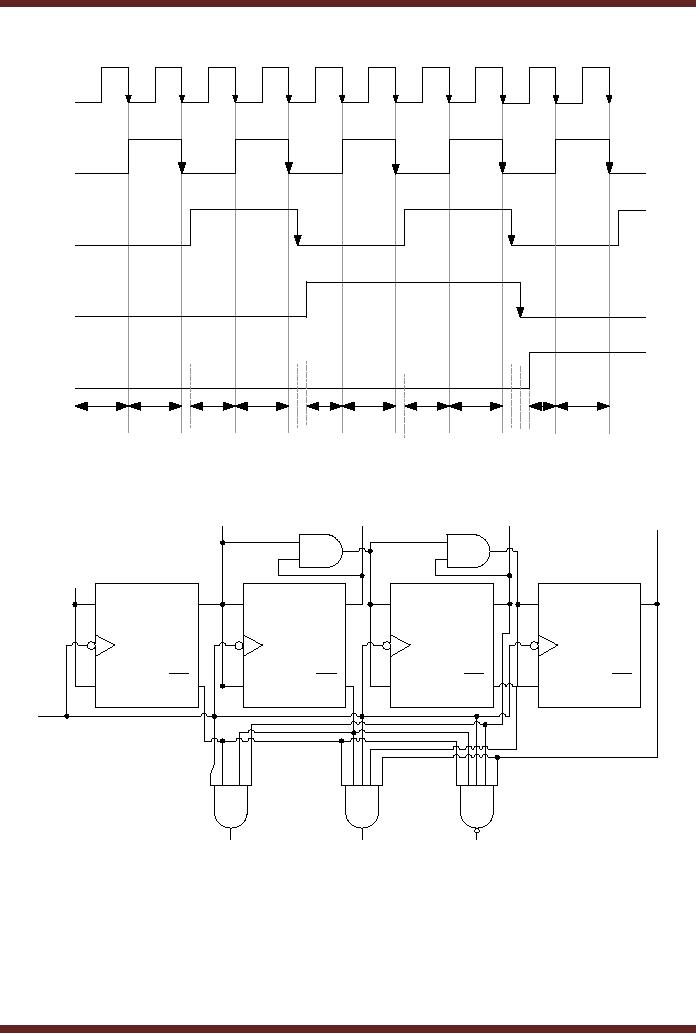
propagation delay due to ripple effect in Asynchronous counters, discussed earlier causes
these Asynchronous counters to work erratically. The propagation problem also exists in
Synchronous counters to some degree due to the propagation delays from the clock transition
to the Q output of the flip-flop which varies slightly for each flip-flop. The timing diagram for the
decoder circuit shows that the decoder outputs are activated for different time intervals at
different intervals which are not in a proper sequence. Figure 29.4b. The counter output for
count 2 is detected by the AND gate decoder during interval t 2A to t 3 and again for a very short
interval at t 4 . Similarly, the counter output 8 is selected for a very short duration between
intervals t AB and t 9 . The decoder outputs for very short durations at interval t 2 , t 4 , t 6 and t 8 are
known as `gliches'.
Glitches can be eliminated by enabling the decoder outputs after the glitches have
settled down. Glitches are removed by using the clock signal to enable the decoder circuit.
Figure 29.5. The clock signal is connected to the inputs of each of the three decoder gates.
During the second, positive half of the clock signal the three gates are enabled, all the glitches
occur during the first negative half of the clock cycle during which the decoder gates are
disabled. This method is known as Strobing method where the decoder outputs are activated
after some delay allowing the glitches to settle down.
296
CS302 - Digital Logic & Design
CLOCK
Input
F 0
Output
F 1
Output
F 2
Output
F 3
Output
0
1
0
2
3
20 4
5
4
6
7
640
9
t 2 t 2A
t 3
t 4 t 4A t 5
t 6
t 7
t 8 t A8 t 9
t 10
t 1
Figure 29.4b Decoded Outputs of Synchronous Counter
F 1
F 2
F 0
F 3
1
SET
SET
SET
SET
J
Q
J
Q
J
Q
Q
J
flip-flop 1
flip-flop 2
flip-flop 3
flip-flop 4
K
Q
K
Q
K
Q
Q
K
CLR
CLR
CLR
CLR
CLK
Active-high
Active-high
Active-low
select 4
select 8
select 12
Figure 29.5
The Decoder circuit connected to remove glitches
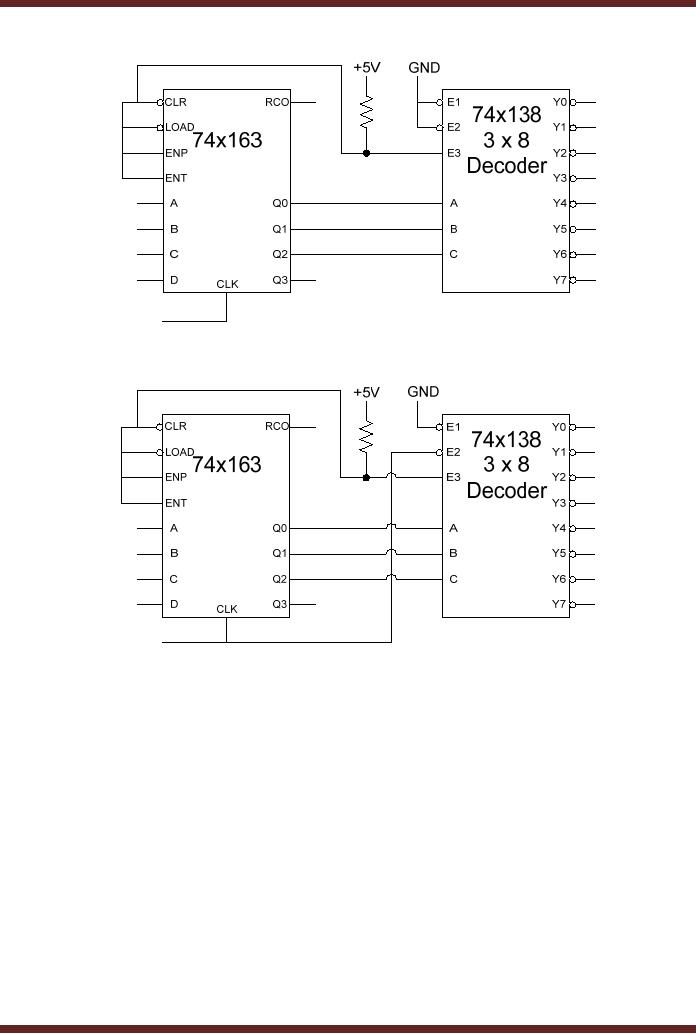
Glitches occur even with Integrated circuits due to different propagation delays
between the clock transition and the variable path lengths between different inputs and outputs
within the integrated circuit. The Glitches that occur at the output of a 74x 138 3-to-8 decoder
connected to a 74HC163 counter can be removed by enabling the decoder during the second
half of the clock signal. Figure 29.6
297
CS302 - Digital Logic & Design
Figure 29.6
74x163 Counter output Decoded using a 3 x 8, 74x138 Decoder
Figure 29.7
74x138 Decoder enabled by a clock signal
Counter Applications
1. Digital Clock
The primary use of counter is in counting applications and sequencing through a set of
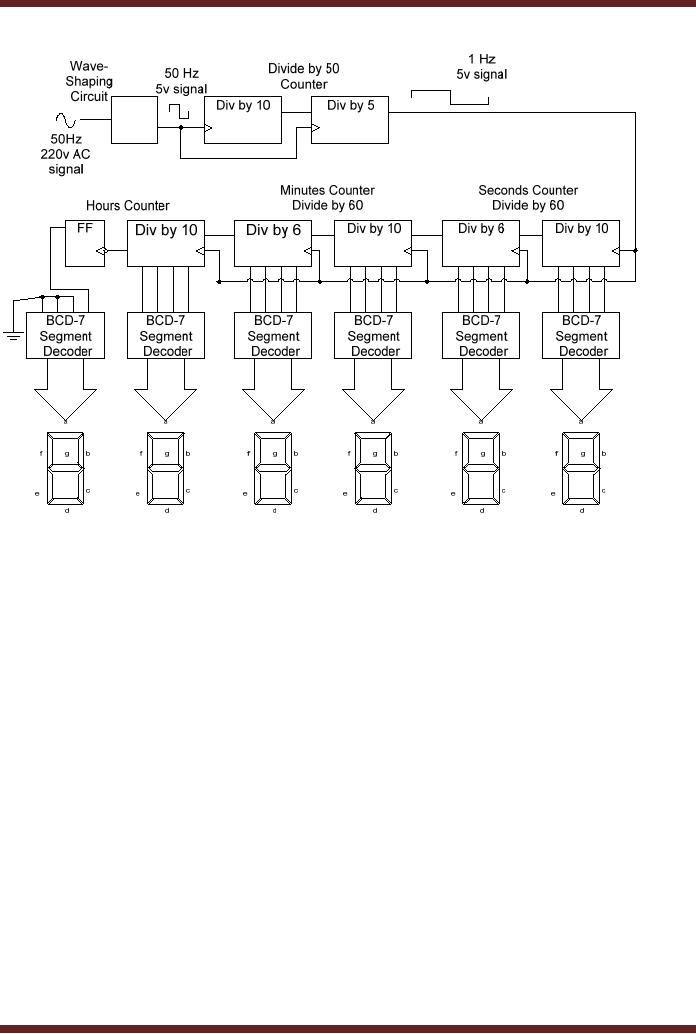
operations. A digital clock can be implemented using the AC 50 Hz frequency as the clock
signal. Figure 29.8
In the digital clock circuit the 50 Hz, 220 volt ac mains sinusoidal signal is shaped into
a 50 Hz, 5 volt square-wave signal. A divide-by-50 counter divides the input 50 Hz signal to a
1 Hz signal. The Seconds, divide-by-60 counter counts up to sixty seconds (0 to 59). The
Minutes, divide-by-60 counter also counts up to sixty minutes (0-59). The Hours, decade
counter counts from 0 to 9. The flip-flop connected to the output of the decade counter is set to
0 or 1 to represent hours from 0 to 9 and 10 to 12 respectively.
298
CS302 - Digital Logic & Design
Figure 29.8
Digital Clock Circuit
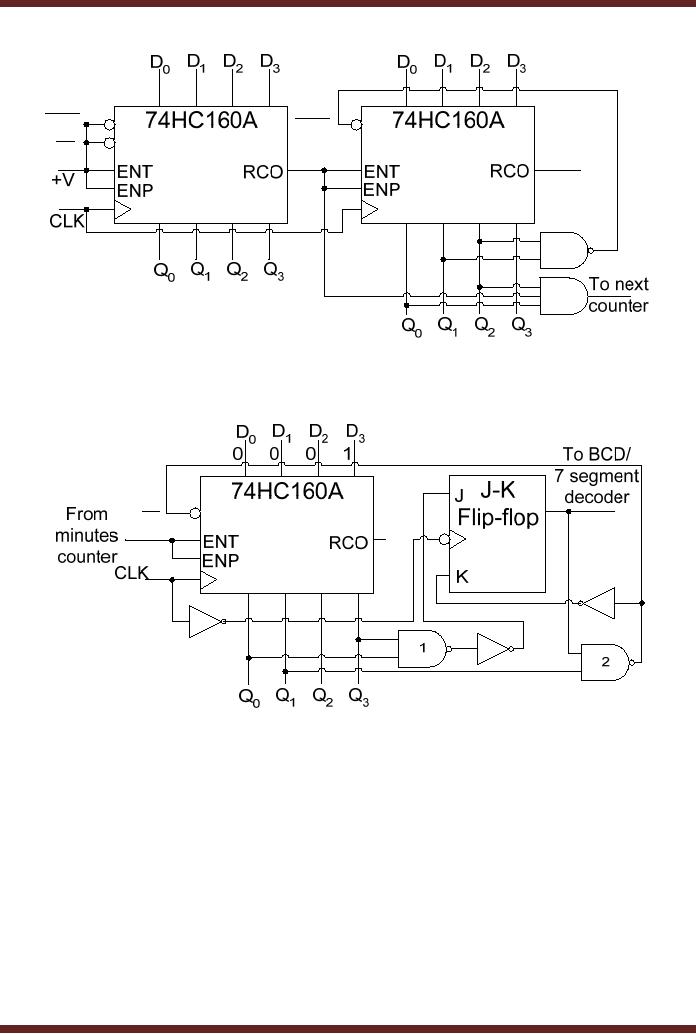
The circuit diagram of the Divide by 60 Seconds and Minutes counter is shown in figure
29.9. The 74HC160A decade counter is sued which has Asynchronous clear. The divide by 60
counter is implemented by cascading two 74HC160A counters. The least significant counter
which is the units counter is configured as a decade counter and counts from 0000 to 1001.
On reaching the terminal count value, the RCO output of the Units counter is set to high which
enables the tens counter. The tens counter is configured as a Mod-6 counter, thus it counts
from 000 to 101. The NAND gate output is set to low when the counter counts up to 110, the
NAND gate output is connected to the asynchronous clear input which resets the counter to
000. When the tens counter reaches its terminal count 101, and the units counter reaches its
terminal count 1001, the AND gate output is set to logic high to indicate the terminal count 59
of the divide by 60 counter. The output of the AND gate is connected to the counter enable
pins ENT and ENP of the next stage, thus on reaching the terminal count the next stage is
enabled and the count is incremented by 1 on a clock transition.
The hours counter is implemented using a single decade counter and a flip-flop. Two
counters are not required as the hours counter counts 12 unique output states. Implementation
of a Mod-12 requires 5 flip-flops. Figure 29.10
299
CS302 - Digital Logic & Design
CLR
CLR
LD
Figure 29.9
Divide by 60 Minutes and Seconds counter
LD
Figure 29.10a Hours Counter Circuit
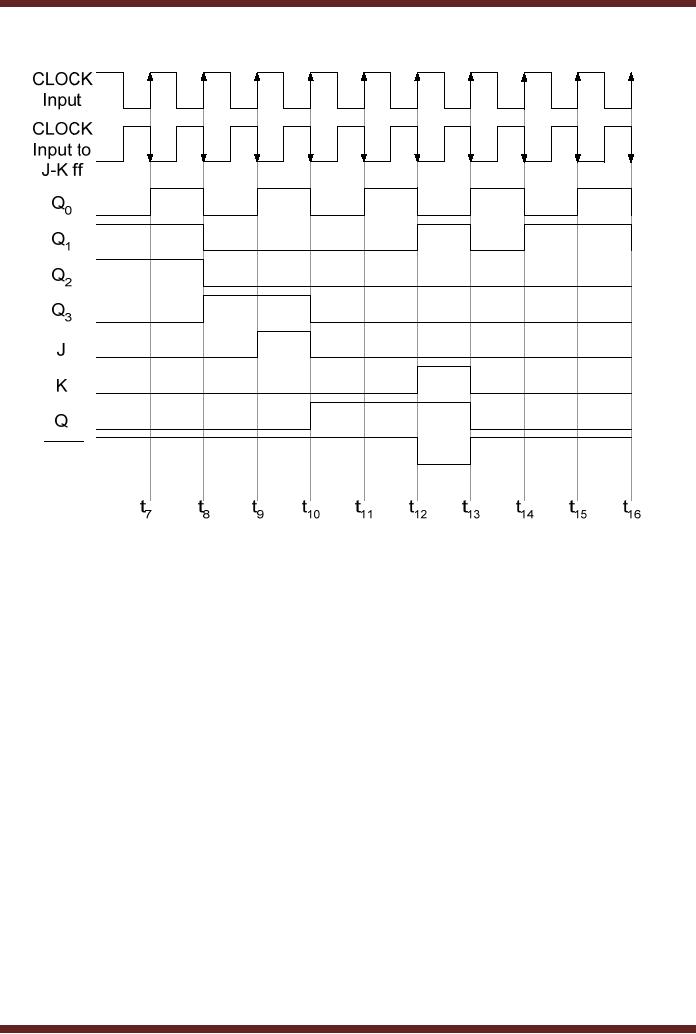
The hours unit counter circuit is configured as a decade counter, counting from 0000 to
1001 when it is enabled by the Minutes counter circuit. The terminal count 1001 is detected by
the NAND gate (1) which sets the J input of the flip-flop to logic 1. The K input of the flip-flop is
at Logic 0, therefore on a clock transition the JK flip-flop output is set to logic 1 when the units
counter recycles to 0000. The NOT gate connected to the clock input of the J-K flip-flop allows
the J-K flip-flop to trigger when the units counter is triggered to count from 1001 to 0000. The
unit counter counts to 0001 and 0010 to represent hours 11 and 12 respectively along with the
output of the J-K flip-flop which is set to logic 1. On the next clock transition when the units
counter counts to 0011 the NAND gate (2) output set to logic 0 reloads the units counter with
the count value 0001 and the J-K flip-flop toggles to 0 output as its K input which is set to logic
1.
300
CS302 - Digital Logic & Design
LOAD
Figure 29.10b Hours Counter timing diagram
2. Frequency Counter
A frequency counter is used to measure the frequency of an input signal. The basis for
the operation of a frequency counter is counting of the clock pulses in predetermined time
interval. The frequency of periodic signal is the number of cycles in a time period of one
second. The frequency of the unknown signal can be calculated by counting the number of
clock pulses of the unknown signal and dividing the count number by the time interval in which
the clock pulses are counted, Figure 29.11
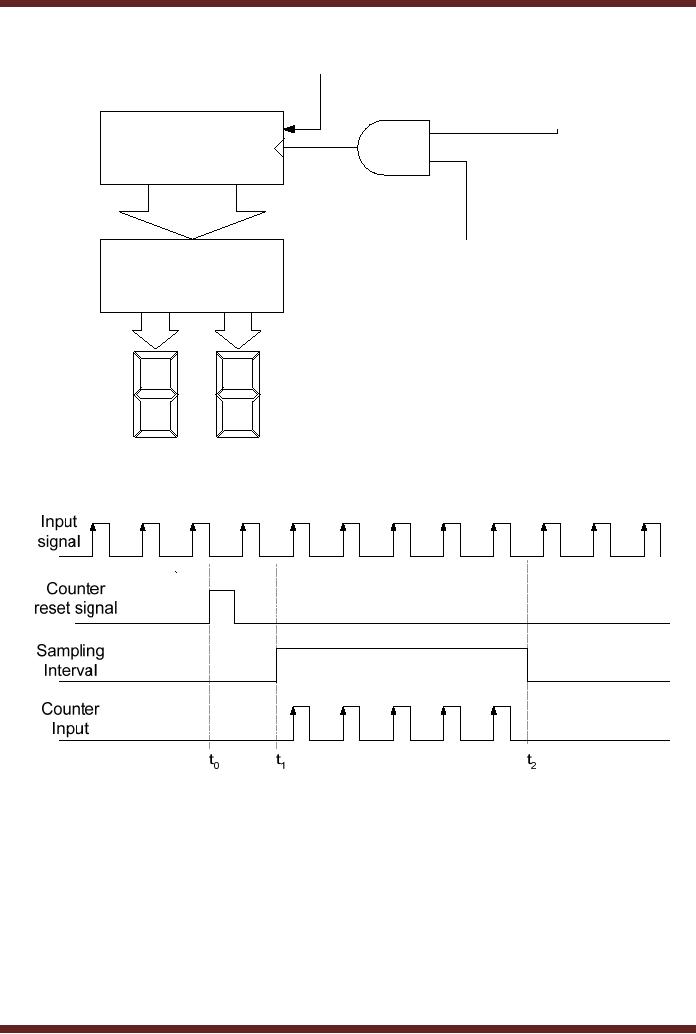
In the circuit shown, the input signal with unknown frequency is applied at the AND
gate input. The second input of the AND gate is connected to a signal which determines the
sampling interval. The signal is set to logic high at interval t 1 to enable the AND gate allowing
the input signal to be connected to the clock input of the counter circuit. The sampling interval
signal is set to logic low at the end of the sampling interval t 2 to disable the AND gate and
inhibit the counter from counting. Before the counter counts the clock pulses of the input signal
it is reset by activating the Asynchronous input to clear the counter at interval t 0 . At the end of
the sampling interval the counter output is displayed on 7-segment displays.
301
CS302 - Digital Logic & Design
Clear
Input Signal with
unknown frequency
Counter
Sampling
BCD & Segment
Interval
Decoder
a
a
g
g
f
f
b
b
c
c
e
e
d
d
Figure 29.11a Frequency Counter Circuit
Figure 29.11b Timing diagram of the Frequency Counter Circuit
The accuracy of the frequency counter depends on the duration of the timing sampling
interval, which must be very accurate. Consider that during a sampling interval of 1 second
4573 clock pulses of the input signal are measured. Thus, the frequency of the unknown signal
is 4573 Hz. If the same input signal is sampled using a 0.1 second sampling interval then
457.3 pulses are counted, which means that either 457 or 458 will be counted depending on
the start of the sampling interval at t 1 . Similarly, if the sampling interval is reduced to 0.01
seconds, the numbers of clock pulses measured are 45.73, which means that either 45 or 46
will be read.
302
CS302 - Digital Logic & Design
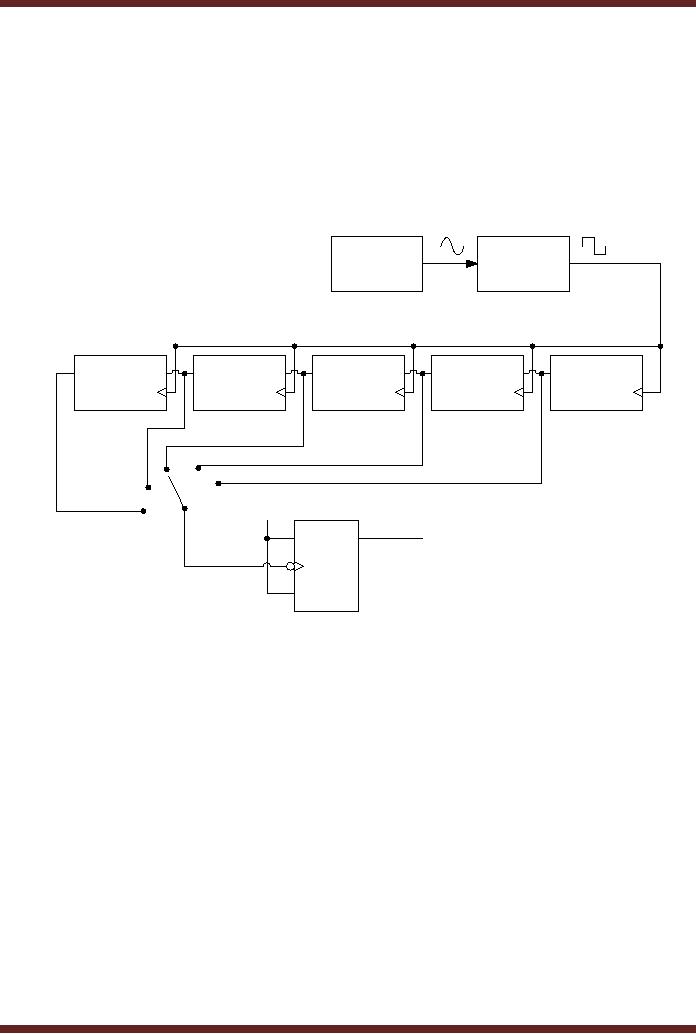
Very accurate sampling intervals are implemented using cascaded counter which is
connected to a very accurate timing signal generated by a crystal controlled oscillator (Astable
multi-vibrator). The output timing signal of each cascade section is available at a switch which
is used to select the appropriate timing signal for controlling the sampling interval. The output
of the switch is connected to the clock input of a negative triggered J-K flip-flop, which divides
the input signal by 2. Thus, when the 1 Hz sampling interval is selected, the signal at the
output of the J-K flip-flop has a time period of 2 seconds. Figure 29.12
100
100
KHz
KHz
Pulse
Crystal
Shaper
Oscillator
Div by 10
Div by 10
Div by 10
Div by 10
Div by 10
100
10
1
10
Hz
Hz
KHz
KHz
1
1
Divide by
J
Q
Hz
2 output
K
Figure 29.12 Cascaded Counter circuit for obtaining accurate sampling intervals
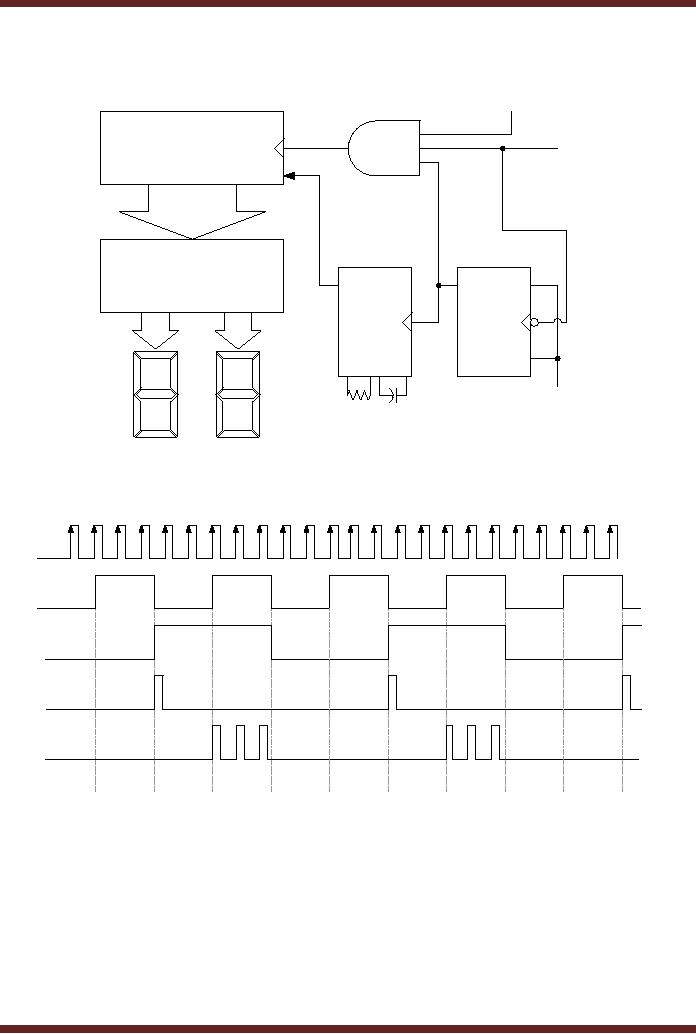
The detailed circuit diagram and the timing diagram of the frequency diagram are
shown in figure 29.13. In the timing diagram the Sampling Interval pulse is obtained from the
output of the J-K flip-flop shown in figure 29.8. The duration of the Sampling interval pulse can
be selected through the switch. The sampling interval signal is connected to the input of the 3-
input AND gate and the clock input of the second J-K flip-flop which toggles its output at each
negative transition of the clock. When the output of the second flip-flop changes to logic 1
(interval t 1 ) it triggers the One-Shot which generates a short output pulse which clears the
Counter circuit. At interval t 2 during the positive half of the sampling interval when the output of
the second J-K flip-flop is high the 3-input AND gate is enabled and the input signal with
unknown frequency is applied at the input of the counter, which count the input signal pulses.
At interval t 3 there is negative transition of the sampling signal, which triggers the second flip-
flop changing its output to logic 0. Logic 0 output of the flip-flop disables the 3-input AND gate
inhibiting the counter from counting. The pulses counted by the counter during interval t 2 to t 3
are directly displayed.
303
CS302 - Digital Logic & Design
Input Signal with
unknown frequency
Counter
Sampling
Clear
Interval
BCD & Segment
Decoder
Q
Q
J
One
Flip-flop
Shot
2
a
a
K
g
g
f
f
b
b
1
c
c
e
e
d
d
Figure 29.13a Detailed circuit diagram of a frequency counter
Input
signal
Sampling
Interval
Output of
flip-flop 2
Counter
reset signal
Counter
Input
t 0
t 1
t 2
t 3
t 4
t 5
t 6
t 7
t 8
t 9
Figure 29.13b Timing diagram of the frequency counter circuit
Design of Synchronous Counters
The counters that have been discussed are binary counters that count in a sequence
either upwards or downwards. The count start and end sequence of a counter can also be set
arbitrarily and the counter can then count up or down with in the terminal count limits.
Counters can also be designed that do not count in a sequence, instead they sequence
304
CS302 - Digital Logic & Design
through a set of predefined arbitrary values. Counters can also be implemented using D flip-
flops instead of J-K flip-flops. Counters are sequential circuits which are designed using
standard set of steps.
Sequential Circuit (State Machine)
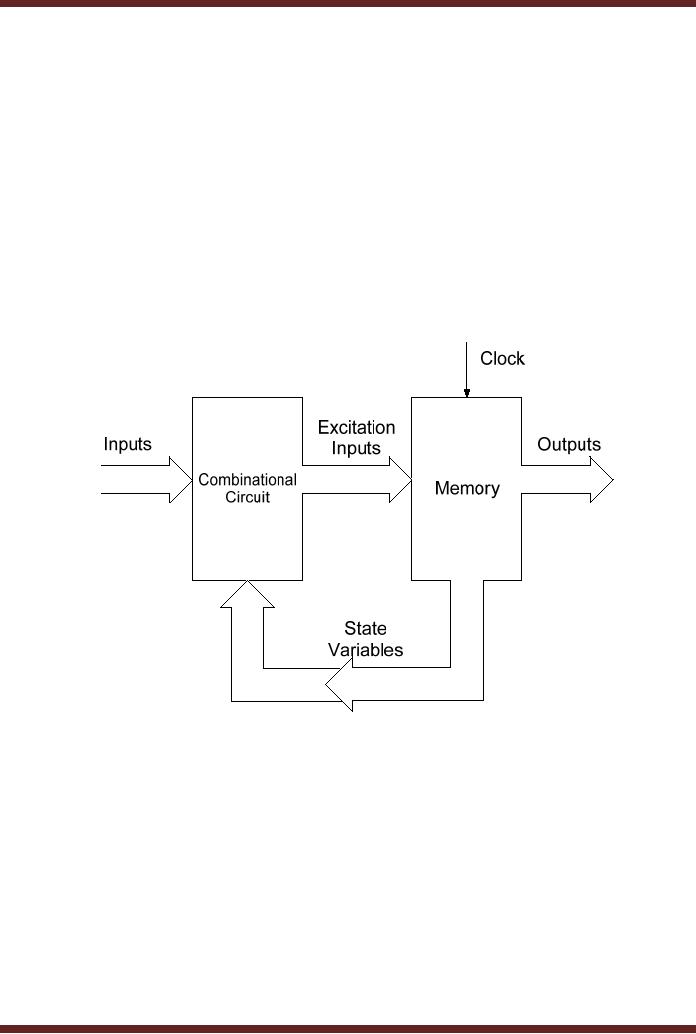
A general Sequential circuit consists of a combinational circuit and a memory circuit
(flip-flop). In a clocked Sequential circuit the memory element has a clock input. At any given
instant the memory element is in its present state. On a clock transition the output of the
memory element changes to the next state. The next state is determined by the inputs applied
at the memory input at the time of clock transition. The inputs to the memory which allow the
memory to change its state on a clock transition are known as excitation inputs or excitation
variables. The present state of the memory is represented by state variables. The state
variables and the inputs to the sequential circuit determine the sequential circuit output. Figure
29.14
Figure 29.14 Clocked Sequential Circuit Block diagram
Design Procedure
The design procedure is based on a number of steps starting from defining the state
diagram and ending at the implementation of State machine.
1. State Diagram
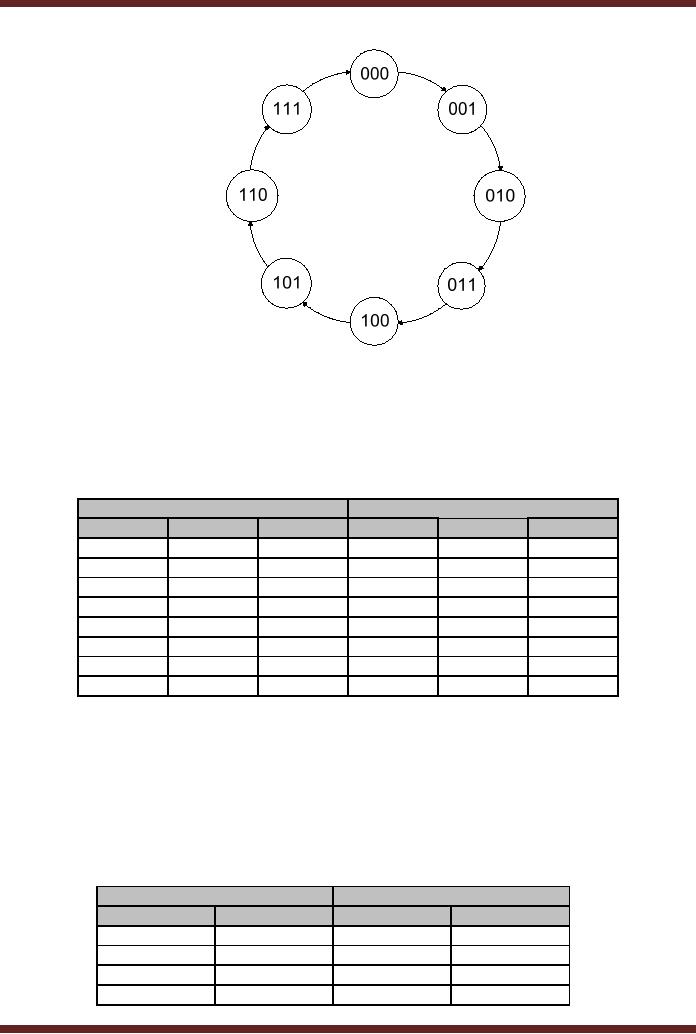
A sequential circuit (state machine) is described by a state diagram, which shows the
sequence of state through which the sequential circuit progresses when it is clocked. The state
diagram of a 3-bit Synchronous Up-Counter (sequential circuit) is shown in the figure. 28.3
305
CS302 - Digital Logic & Design
Figure 28.3
State diagram of a 3-bit Up-Counter
2. Next-State Table
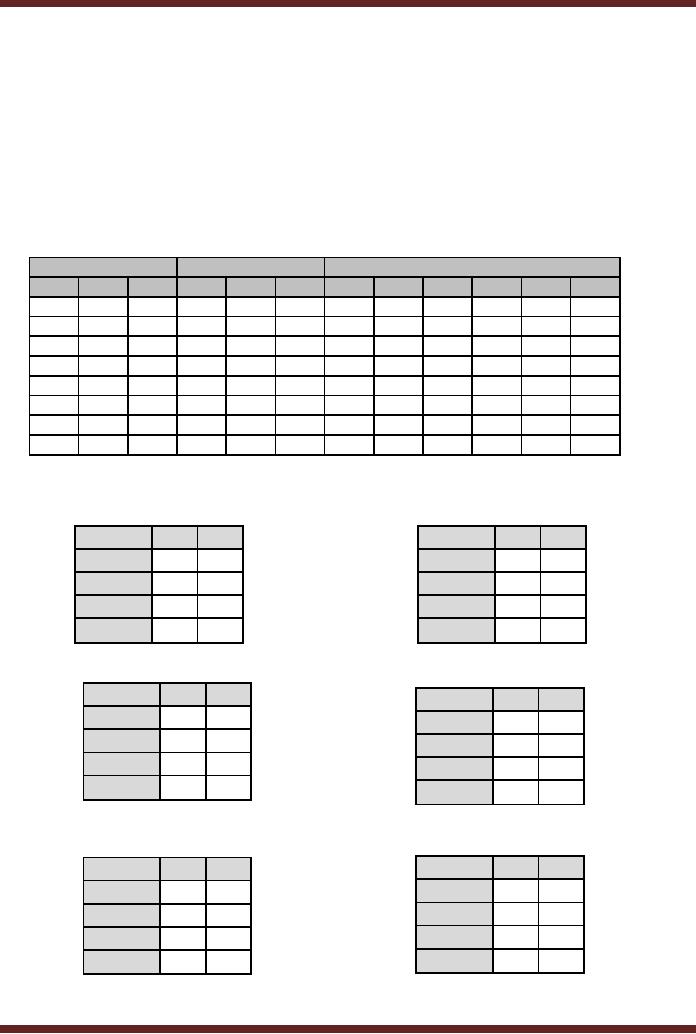
Once the state diagram of the sequential circuit is defined, a Next-State Table is
derived which lists each present state and the corresponding next state. The next state is the
state to which the sequential circuit switches when a clock transition occurs. Table 28.1
Present State
Next State
Q 2
Q 1
Q 0
Q 2
Q 1
Q 0
0
0
0
0
0
1
0
0
1
0
1
0
0
1
0
0
1
1
0
1
1
1
0
0
1
0
0
1
0
1
1
0
1
1
1
0
1
1
0
1
1
1
1
1
1
0
0
0
Table 28.1
Next-State Table for a 3-bit Up-Counter
3. Flip-flop Transition Table
The Memory element of the Sequential circuit is implemented using flip-flops. The
number of flip-flops used is determined by the total number of states. When there is a clock
transition at the clock input of the flip-flops they change from their present state to the next
state. The Flip-flop transition table lists all the possible flip-flop input combinations which
allows the present state to change to the next state on a clock transition. The flip-flop
transition table is based on the flip-flop used (D, S-R or J-K). Table 28.2
Flip-flop Inputs
Output Transitions
J
K
Q t
Q t+1
0
x
0
0
1
x
0
1
x
1
1
0
x
0
1
1
306
CS302 - Digital Logic & Design
Table 28.2
J-K flip-flop Transition table
4. Karnaugh Maps
For each state variable shown in the Next-State table, the change from present state to
the next state on a clock transition depends upon the J-K inputs. Table 28.3. Considering the
state variable Q 2 , J 2 and K 2 inputs set to 0 and x (don't care) allow Q 2 to change from present
state 0 to next state 0 shown in the first row. Similarly, the state variable Q 0 changes from 1 to
0 when J 0 and K 0 inputs are set at x (don't care) and 1 respectively. The table is completed
using the information in the Next-State table and the J-K flip-flop transition table. The J-K
inputs can be directly mapped to Karnaugh maps. Table 28.4
Present State
Next State
J-K flip-flop inputs
Q 2
Q 1
Q 0
Q 2
Q 1
Q 0
J 2
K 2
J 1
K 1
J 0
K 0
0
0
0
0
0
1
0
x
0
x
1
x
0
0
1
0
1
0
0
x
1
x
x
1
0
1
0
0
1
1
0
x
x
0
1
x
0
1
1
1
0
0
1
x
x
1
x
1
1
0
0
1
0
1
x
0
0
x
1
x
1
0
1
1
1
0
x
0
1
x
x
1
1
1
0
1
1
1
x
0
x
0
1
x
1
1
1
0
0
0
x
1
x
1
x
1
Table 28.3
J-K flip-flop input table
Q 2 Q 1 /Q 0
0
1
Q 2 Q 1 /Q 0
0
1
00
0
0
00
x
x
01
0
1
01
x
x
11
x
x
11
0
1
10
x
x
10
0
0
Table 28.4a
Karnaugh Map for J 2 and K 2 inputs
Q 2 Q 1 /Q 0
0
1
Q 2 Q 1 /Q 0
0
1
00
0
1
00
x
x
01
x
X
01
0
1
11
x
X
11
0
1
10
0
1
10
x
x
Karnaugh Map for J 1 and K 1 inputs
Table 28.4b
Q 2 Q 1 /Q 0
0
1
Q 2 Q 1 /Q 0
0
1
00
x
1
00
1
x
01
x
1
01
1
x
11
x
1
11
1
x
10
x
1
10
1
x
Table 28.4c
Karnaugh Map for J 0 and K 0 inputs
307
CS302 - Digital Logic & Design
5. Logic expressions for Flip-flop Inputs
Simplified expressions for J 2 -K 2 , J 1 -K 1 and J 0 -K 0 are directly obtained from the
Karnaugh maps.
J 2 = Q 1 Q 0
K 2 = Q 1 Q 0
J 1 = Q 0
K 1 = Q 0
J 0 = 1
K 0 = 1
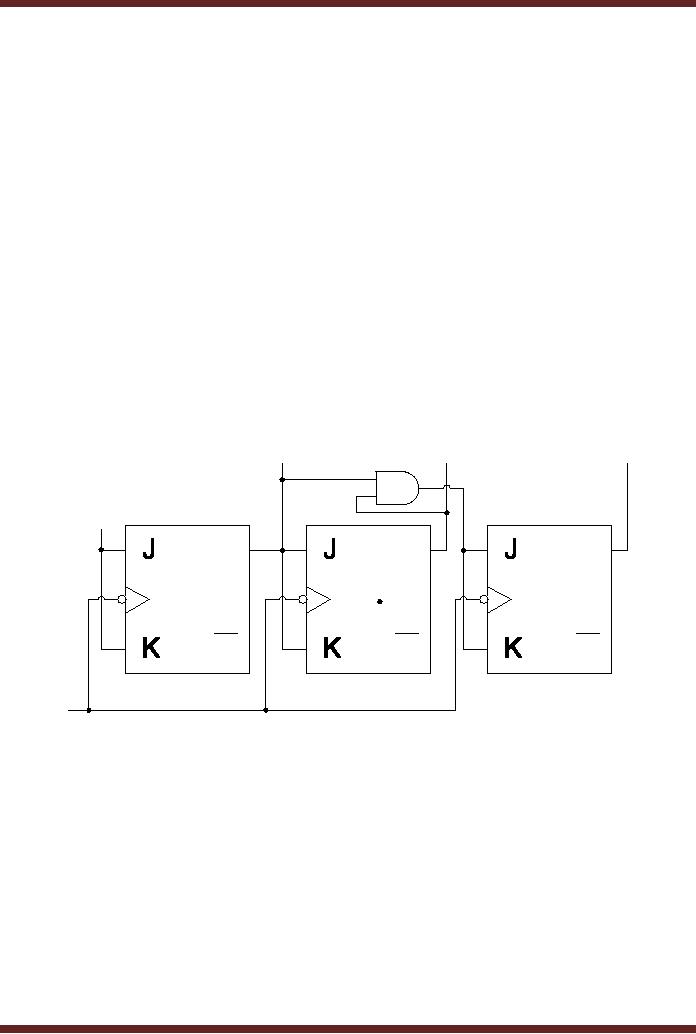
6. Sequential Circuit Implementation
The Boolean expressions obtained in the previous step are implemented using logic
gates. The sequential circuit implemented is shown in figure 28.4.
Q 0
Q 1
Q 2
1
SET
SET
SET
Q
Q
Q
flip-flop 1
flip-flop 2
flip-flop 3
Q
Q
Q
CLR
CLR
CLR
CLK
Figure 28.4
Implementation of the Sequential Circuit
Implementing a 3-bit Up/Down Counter
1. State Diagram
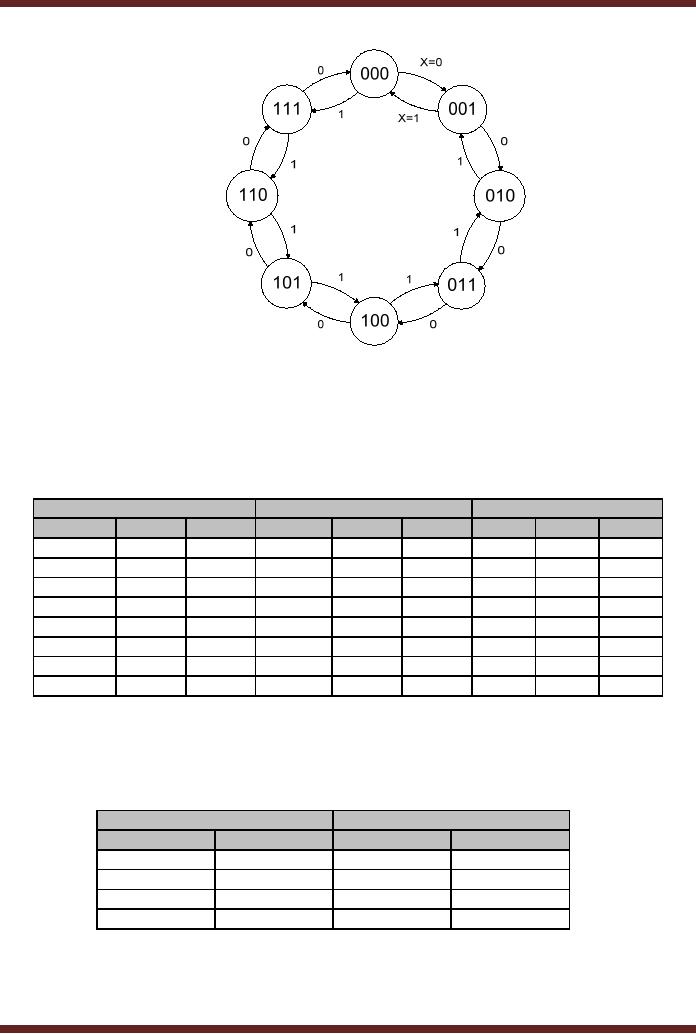
The state diagram of a 3-bit Up/Down Synchronous Counter is shown in the figure.
28.5 . X=0 and X =1 indicates that the counter counts up when input X = 0 and it counts down
when X =1.
308
CS302 - Digital Logic & Design
Figure 28.5
State diagram of a 3-bit Up-Counter
2. Next-State Table
The next state is the state to which the sequential circuit switches when a clock
transition occurs. Table 28.5. The next state outputs for X=0 and X=1 are shown separately.
Present State
Next State X=0
Next State X=1
Q 2
Q 1
Q 0
Q 2
Q 1
Q 0
Q 2
Q 1
Q 0
0
0
0
0
0
1
1
1
1
0
0
1
0
1
0
0
0
0
0
1
0
0
1
1
0
0
1
0
1
1
1
0
0
0
1
0
1
0
0
1
0
1
0
1
1
1
0
1
1
1
0
1
0
0
1
1
0
1
1
1
1
0
1
1
1
1
0
0
0
1
1
0
Table 28.5
Next-State Table for a 3-bit Up-Counter
3. Flip-flop Transition Table
The flip-flop transition table is based on the J-K flip-flop. Table 28.6
Flip-flop Inputs
Output Transitions
J
K
Q t
Q t+1
0
x
0
0
1
x
0
1
x
1
1
0
x
0
1
1
Table 28.6
J-K flip-flop Transition table
309
CS302 - Digital Logic & Design
4. Karnaugh Maps
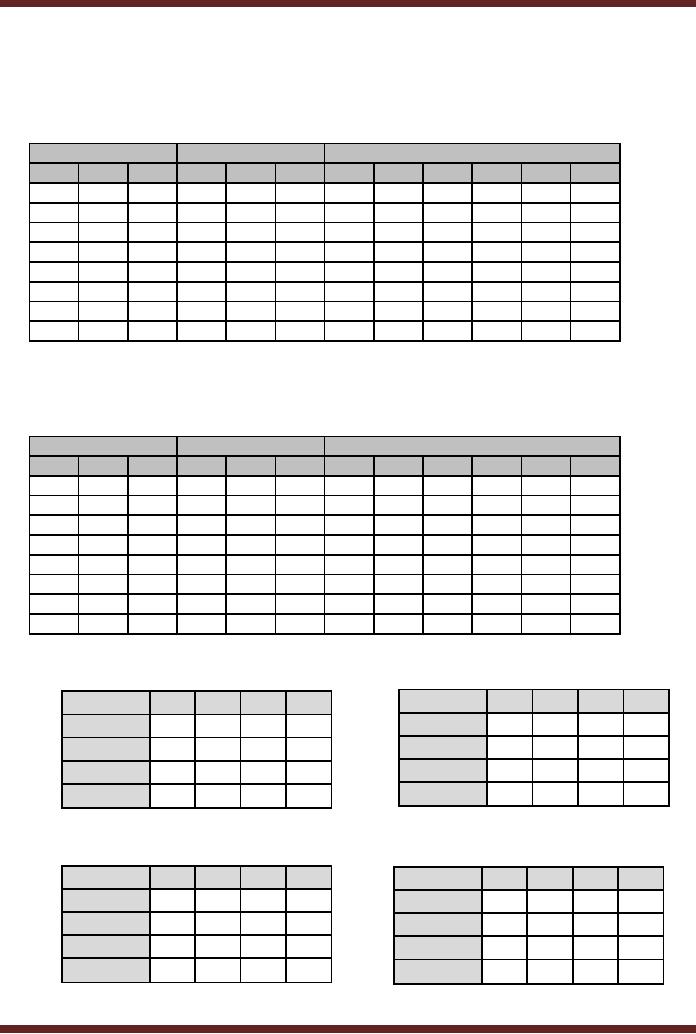
The J-K flip-flop inputs for change in state variables when X=0 and X=1 are shown in
the table 28.7 . The J-K inputs can be directly mapped to 4-Variable Karnaugh maps. Table
28.8.
Present State
Next State X=0
J-K flip-flop inputs
Q 2
Q 1
Q 0
Q 2
Q 1
Q 0
J 2
K 2
J 1
K 1
J 0
K 0
0
0
0
0
0
1
0
x
0
x
1
x
0
0
1
0
1
0
0
x
1
x
x
1
0
1
0
0
1
1
0
x
x
0
1
x
0
1
1
1
0
0
1
x
x
1
x
1
1
0
0
1
0
1
x
0
0
x
1
x
1
0
1
1
1
0
x
0
1
x
x
1
1
1
0
1
1
1
x
0
x
0
1
x
1
1
1
0
0
0
x
1
x
1
x
1
Table 28.7a
J-K flip-flop input table for X=0
Present State
Next State X=1
J-K flip-flop inputs
Q 2
Q 1
Q 0
Q 2
Q 1
Q 0
J 2
K 2
J 1
K 1
J 0
K 0
0
0
0
1
1
1
1
x
1
x
1
x
0
0
1
0
0
0
0
x
0
x
x
1
0
1
0
0
0
1
0
x
x
1
1
x
0
1
1
0
1
0
0
x
x
0
x
1
1
0
0
0
1
1
x
1
1
x
1
x
1
0
1
1
0
0
x
0
0
x
x
1
1
1
0
1
0
1
x
0
x
1
1
x
1
1
1
1
1
0
x
0
x
0
x
1
Table 28.7b
J-K flip-flop input table for X=1
Q 2 Q 1 /Q 0 X
00
01
11
10
Q 2 Q 1 /Q 0 X
00
01
11
10
00
x
x
x
x
00
0
1
0
0
01
x
x
x
x
01
0
0
0
1
11
0
0
0
1
11
x
x
x
x
10
0
1
0
0
10
x
x
x
x
Table 28.8a
Karnaugh Map for J 2 and K 2 inputs
Q 2 Q 1 /Q 0 X
00
01
11
10
Q 2 Q 1 /Q 0 X
00
01
11
10
00
0
1
0
1
00
x
x
x
x
01
x
x
x
x
01
0
1
0
1
11
x
x
x
x
11
0
1
0
1
10
0
1
0
1
10
x
x
x
x
Table 28.8b
Karnaugh Map for J 1 and K 1 inputs
310
CS302 - Digital Logic & Design
Q 2 Q 1 /Q 0 X
00
01
11
10
Q 2 Q 1 /Q 0 X
00
01
11
10
00
x
x
1
1
00
1
1
x
x
01
x
x
1
1
01
1
1
x
x
11
x
x
1
1
11
1
1
x
x
10
x
x
1
1
10
1
1
x
x
Table 28.8c
Karnaugh Map for J 0 and K 0 inputs
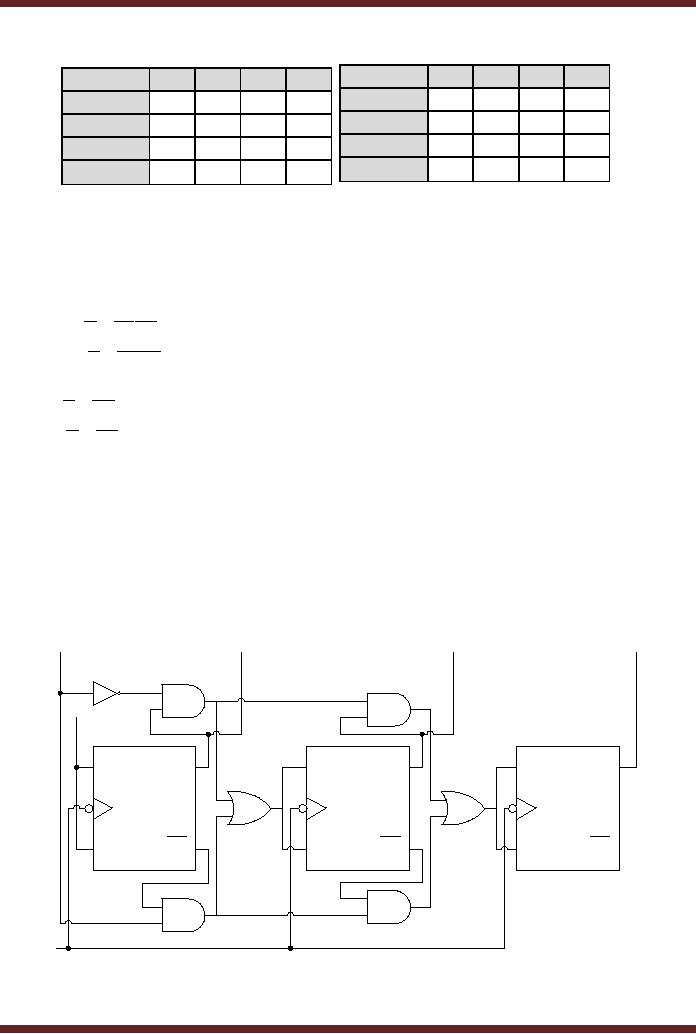
5. Logic expressions for Flip-flop Inputs
Simplified expressions for J 2 -K 2 , J 1 -K 1 and J 0 -K 0 are directly obtained from the
Karnaugh maps.
J 2 = Q 1 Q 0 X + Q 1 Q 0 X
K 2 = Q 1 Q 0 X + Q 1 Q 0 X
J 1 = Q 0 X + Q 0 X
K 1 = Q 0 X + Q 0 X
J 0 = 1
K 0 = 1
6. Sequential Circuit Implementation
The Boolean expressions obtained in the previous step are implemented using logic
gates. The sequential circuit implemented is shown in figure 28.6.
X=0 (up)
Q 0
Q 1
Q 2
X=1 (down)
1
SET
SET
SET
J
Q
J
Q
J
Q
flip-flop 2
flip-flop 1
flip-flop 3
K
Q
K
Q
K
Q
CLR
CLR
CLR
CLK
Figure 28.6
Implementation of the Sequential Circuit
311
Design a Decade Counter Using T Flip-flops
Source: https://zeepedia.com/read.php?integrated_circuit_up_down_decade_counter_design_and_applications_digital_logic_design&b=9&c=29

Postar um comentário for "Design a Decade Counter Using T Flip-flops"