Read on Rising Edge Write on Falling Edge
This commodity was originally published on x-engineer.org
Thanks to ten-engineers for their contribution.
--
Signal edge detection is a technique widely used in embedded software, model based development and electronics. A indicate edge is defined as the transition of the signal from aloftier state to adepression land or vice-versa. Depending on the blazon of transition, there are three unlike types of edge detection:
- ascent edge: when the input betoken is transitioning from a low state (e.thou. 0) to a loftier land (e.k. 1)
- falling border: when the input signal is transitioning from a loftier state (e.g. one) to a low country (due east.thousand. 0)
- either edge: when the input signal is irresolute state, from high to low or from low to high

Image: Signal edge detection
The detection of the border is washed on discrete signals. The edge detection is represented past an output Boolean signal, which has the value1 (true) merely during atime step, when the state change has occurred,
Signal edge detection is useful in fortimers,counters or clock resets, forsignal state updates or fortriggering a fix of functions / algorithms.
Ascent edge detection
A rising edge is the transition of a signal from a depression state to a high state. In Xcos, for a discrete signal, this transition can be detected by comparing the actual value of the signalu[1000] with the previous valueu[k-1].

Image: Xcos model – rising border detection
In the Xcos cake diagram above,Sig_Dec represents the input signal, which is changing country. TheFilibuster block has theDiscretization fourth dimension pace ready to0.001 southward. This ways that the output of theDelay block will exist delayed withi ms. If the current value of the indicate is bigger than the value information technology hadone ms agone, arising edge had occurred. TheRisngEdge_B output point will be a Boolean pulse signal for the edge detection.
Falling edge detection
The falling edge detection is washed in a similar fashion as the rise edge. The only departure is that we check if the current value of the indicate is lower than the value it had once step before.

Image: Xcos model – falling edge detection
Either edge detection
An either edge detection looks later on both ascent or falling edges. If any of them occurs, the Boolean output is gear up to true but during the state transition time step.

Image: Xcos model – either edge detection
The easiest way to implement an either edge is by performing a logical OR betwixt the rising edge and falling border detection.
To test the signal border detection nosotros are going to use square wave defined with aPulse Generator block from the Xcos palette. The parameters of the indicate are:
- Stage delay (secs):
0 - Pulse Width (% of period):
50 - Period (secs):
two - Amplitude:
1
The output of the signal generator is fed to the signal border detection functions described above. The shape of the square moving ridge and the outputs of the edge detection subsystems are then plotted in aScope block, triggered at0.001 s.
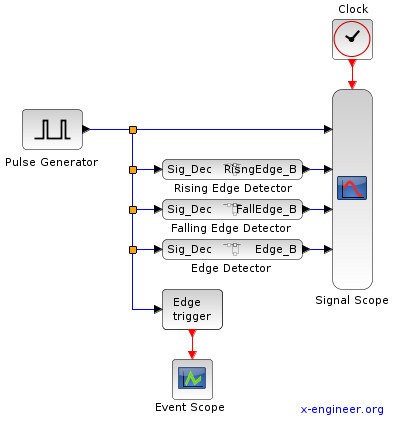
Image: Xcos model – pulse edge detection
Running the model for6 s outputs the following graphical window:

Image: Pulse edge detection output
The first, upper point plot is theinput square wave. The second plot contains therise edge detection, the third plot is thefalling edge detection and the quaternary plot is theeither edge detection. For a improve visualization, theDelayblock has the parameterDiscretization time step set to0.1 south, which makes the Boolean edge detection signals to be true for100 ms. As yous can see, the either edge is contains both rising and falling edge detection.
Edge detection can be performed besides with the Xcos cakeEdge trigger. Every time at that place is a state change in the input indicate (rising or falling), the block will output anoutcome. This can be used to trigger other discrete Xcos blocks. In our example we use aEvent Telescopic block to plot the occurrence of the edge detection events.

Image: Edge detection effect
As you can see the border detection events occur in the aforementioned fourth dimension with the border detection pulses.
Edge detection application instance
Nosotros tin can use edge detection to update the value / country of a betoken. In the following example, we'll utilise both the edge detection pulses and events, to sample/update a signal with the values of a sine wave. We expect to have the aforementioned results for both methods (edge pulse and effect).

Image: Border detection (bespeak and event) instance
Having a time period of2 southward and a duty cycle ofl %, thePulse generator block will produce a square wave which will alter state everyi south. The either edge detection subsystem will generate ai ms pulse (set by theDelay block), which will update the value of the signal after theDynamic switch block. When the edge pulse is0 (flase), the output of the switch volition exist the previous value of the signal.
The edge detection machinery volition sample the sine wave every1 s. The aforementioned behavior is obtained using theEdge trigger block. At every border detection an result is generated which will trigger theSample and Agree block.
The outputs of both sampling methods (border detection pulse and outcome) are fed in aScope block (updated every1 ms).

Image: Edge detection (betoken and consequence) example plot
The upper plot represents the edge detection pulse. The eye contains the sine wave and its sampling with theDynamic switch. The lower plot contains the sine wave and its update based on theSample and Hold border upshot trigger. As you tin can see, both methods produce the same result.
This edge detection mechanism volition exist used to reset a timer, merely this is the topic of another Xcos tutorial.
Source: https://www.scilab.org/signal-edge-detection

Postar um comentário for "Read on Rising Edge Write on Falling Edge"